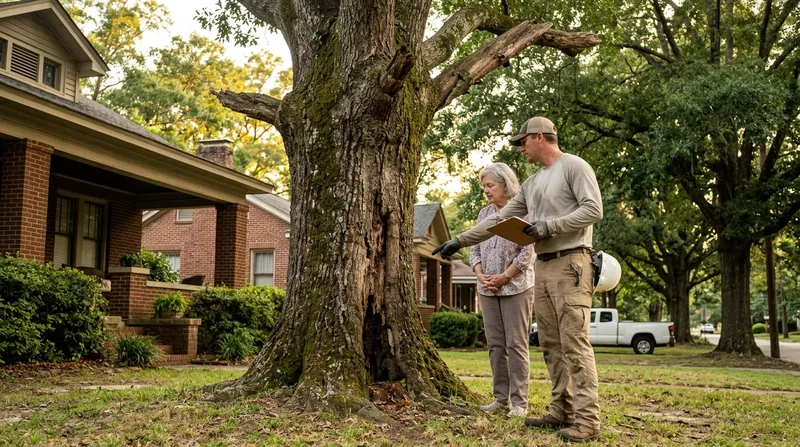




Columbia's tree canopy tells the story of the Midlands: towering willow oaks and water oaks shading Craftsman bungalows in Shandon, massive live oaks anchoring Victorian porches in Elmwood Park, and tall loblolly pines standing over 1950s ranches in Forest Acres and Cayce. But Columbia's climate and terrain create real hazards. The Fall Line transition from red-clay Piedmont to sandy Sandhills, combined with brutal summer heat, violent afternoon thunderstorms, and occasional ice storms, puts enormous stress on aging root systems and weakens branch structure. An Arborist Consultation in Columbia is not a luxury, it's a practical assessment that protects your home, your neighbors, and your property investment. Whether you're concerned about a 60-year-old oak leaning toward your roof, a pine that's been stressed by drought, or a Bradford pear that's starting to split, we give you facts and options before something fails.
Why Arborist Consultation Matters in Columbia's Climate and Terrain
Columbia sits at a crossroads. The humid Piedmont heat (often near 100 degrees in summer) combined with clay-heavy soils creates drought stress that weakens trees from the inside out. Hypoxylon canker, a fungal disease, preys on stressed oaks. Southern pine beetle and Ips beetle kill pines in waves. Then come the storms: summer thunderstorms with straight-line winds snap branches and uproot shallow-rooted trees, and rare ice storms coat limbs with weight that snaps them like matchsticks. An arborist consultation gives you the information you need to act before nature forces your hand.
- We identify internal decay, hollow sections, and structural weakness that are invisible from the ground.
- We spot disease and pest damage early, when treatment or removal can still save the tree or protect your home.
- We assess wind and storm risk, especially for trees near roofs, power lines, fences, and neighbors' properties.
- We provide a written report suitable for insurance claims, permit applications, and HOA documentation.
- We recommend a phased care plan: pruning, cabling, removal, or monitoring based on your budget and timeline.
A consultation now can prevent a $5,000 emergency removal or a liability claim later.
Real scenario: A homeowner in Forest Acres noticed a large water oak showing no obvious signs of trouble. Our arborist found extensive hollow sections in the main trunk and recommended removal before the next storm. Three weeks later, a similar oak two blocks away failed in a thunderstorm and crushed a garage. The consultation cost $150. The emergency removal cost $4,200 and included a liability claim.
For more on the risks specific to your property and the steps we take to keep your home safe, see our tree removal service page.
How We Conduct an Arborist Consultation in Columbia
Our process is straightforward and field-based. We arrive on time, walk your property with you, and spend time looking at each tree you're concerned about. We use basic tools (a resistograph to test wood density, a clinometer to measure height and lean, a magnifying glass to spot pest damage and canker) and our trained eye to build a complete picture. We don't rush. We ask questions about the tree's history, any storms or damage you've seen, and what you want from your property. By the end of the visit, you'll know what we found and what we recommend.
- We inspect the crown, trunk, major limbs, and root collar for signs of disease, decay, pest damage, or structural defect.
- We evaluate the tree's lean, the position of major limbs relative to your home and property lines, and the likelihood of failure.
- We identify the tree species and any specific vulnerabilities common to that species in Columbia's climate.
- We discuss options: leave it as is with monitoring, prune to reduce risk, cable or brace for support, or remove it entirely.
- We provide a written report with photos, findings, and recommendations, suitable for your records or your insurance company.
Most consultations take 45 minutes to an hour, depending on the number of trees and the complexity of what we find.
Example: A homeowner in Irmo was concerned about a large sweetgum near their deck. Our arborist found the tree was healthy but poorly structured, with two major limbs competing for dominance and rubbing against each other. We recommended a targeted pruning to reduce the risk of limb failure and improve the tree's long-term form. The consultation identified the problem, the pruning job followed, and the tree is now structurally sound. The homeowner avoided a surprise failure and got years of additional life from a valuable tree.
Learn more about how we approach pruning and structural care on our tree trimming and pruning page.
Assessment Methods and What We Look For
| Approach | Description | Best for |
|---|---|---|
| Visual inspection | Crown shape, canopy density, bark condition, visible cavities, pest damage, lean, and branch structure from ground level and closer look. | All trees; first step of every consultation. |
| Resistograph testing | A small probe measures wood density through the trunk to detect internal decay, hollow sections, and rot that are not visible externally. | Trees with suspicious bark, cavities, or a history of damage; suspected decay in oaks and pines. |
| Height and lean measurement | We use a clinometer and measuring tape to calculate the tree's height, the angle of lean, and the proximity of the crown to structures. | Trees near homes, fences, or power lines where fall risk and impact zone matter. |
| Species and pest assessment | We identify the tree species and look for signs of hypoxylon canker, pine beetle, scale, canker, anthracnose, and other common Columbia diseases. | Oaks showing stress; pines with discolored needles; trees in decline. |
| Root and base evaluation | We examine the root collar, look for girdling roots, soil compaction, and signs of root disease or damage from construction or grade change. | Trees on compacted clay lots; trees that have declined after nearby construction or grading. |
Each method gives us a different piece of the puzzle. Together, they create a complete picture of the tree's health and risk.
Arborist Consultation Cost in Columbia: What to Expect
An arborist consultation in Columbia starts at $95 for a single tree on an accessible residential lot. That price covers the on-site visit, the inspection using our standard tools, and a basic verbal summary. If you need a written report with photos and specific recommendations, expect to add $50 to $100 depending on the detail and number of trees. For larger properties, multiple trees, or complex situations (trees near structures, in tight spaces, or with suspected disease), the fee may be higher, but we'll quote it before we start.
Several factors affect the final cost. The size and height of the tree matter because taller trees take longer to assess and may require us to look at more limbs. The number of trees you want evaluated obviously adds to the time. Access is a factor too: if the tree is in a tight backyard, surrounded by fences, or near a slope, inspection takes longer. The species and condition also play a role; a healthy ornamental cherry takes 15 minutes, but a 60-year-old oak with signs of decay may need 30 or 40 minutes of careful inspection.
We always recommend getting two or three estimates Different arborists may see the situation differently, and comparing notes helps you make the best choice for your property and budget. Travel within Columbia and surrounding areas is included in our fee, with no separate mileage charge.
For a complete breakdown of our pricing and to understand how costs scale with job complexity, visit our full pricing page.
Arborist Consultation Near Me: What to Look for When Hiring a Tree Service in Columbia
When you're looking for an arborist consultation near you in Columbia, West Columbia, Cayce, or Forest Acres, take time to vet the company. Request references from past clients and follow up on them. Check that the company carries liability insurance and workers' compensation coverage. A reputable company will provide proof of insurance without hesitation.
A few other practical considerations matter in Columbia specifically. If your tree is protected under a local heritage tree ordinance or if your property is governed by an HOA, mention that upfront. Many cities in the Midlands require a permit before removing a tree above a certain diameter, and some neighborhoods have strict rules about visible tree work. A good arborist consultation will address those requirements and help you understand what permits or approvals you'll need before moving forward. The City of Columbia's Development Services office maintains current ordinances and can answer questions about protected trees and permit requirements.
Always ask for a written estimate before work begins, and make sure the estimate is free and comes with no obligation to hire. A company that won't give you a free consultation or that pressures you to decide on the spot is not worth your time. We offer a free, no-obligation estimate and respond within 24 hours. Call us at (803) 303-6605 or contact us online to schedule your arborist consultation.
Arborist Consultation in Columbia: Pricing Guide
| Service | Price | Details |
|---|---|---|
| Single tree consultation | Starting at $95 | Visual inspection and verbal assessment of one tree on accessible residential lot with recommendations |
| Written report with photos | Starting at $150 | Adds detailed documentation suitable for insurance claims, permits, or HOA approval and record keeping |
| Multiple trees or complex property | On estimate | Properties with three or more trees, tight access, disease concerns, or proximity to structures need on-site quote |
| Travel | Included | No separate mileage or travel fee within Columbia and surrounding service area cities |
| Estimate | Free | No-obligation consultation with response within 24 hours at (803) 303-6605 |
Indicative pricing, the exact cost depends on square footage, finish, and site access. Free personalized estimate within 24h at (803) 303-6605.


